OuiRace

Duration
Apr 2024 - present
Product & Brand Designer
OuiRace
Me (Product & Brand Designer), Raphael B (CEO), Sarah A (PM&Marketing), Antoine H (Lead Developer), 15+ Wonderful Developers, 3+ Marketing Specialists
B2C, B2C, Startup, Mobile App, IOS and Android
Problem
we design an intuitive and inclusive app that allows organizers to easily create races, runners to join from anywhere, and both to benefit from fair, AI-corrected results and meaningful participation for a cause?
Solution
We designed and built OuiRace as a complete digital ecosystem for virtual racing, combining a mobile app for runners, a web platform for organizers, and a public-facing website to promote events and causes.
The mobile app allows runners to participate in races from anywhere, track their run via GPS or GPX, and receive fair, AI-corrected results based on real-time weather, elevation, and location data. One of my core design challenges was making this AI correction legible to users — translating a black-box algorithm into an experience that felt transparent and trustworthy. I designed the result screens and in-race feedback to show runners not just their corrected time, but why it changed: which environmental factors were applied and what that meant for their ranking. Making AI output feel fair, not just technically accurate, was a significant UX problem in itself. The organizer web platform now enables race creators to build fully branded events, set donation goals, manage participants, and monitor live results and impact analytics. The website serves as the public entry point, showcasing races, stories, and fundraising efforts while allowing users to register, donate, or book a demo.
Together, this system empowers NGOs, companies, and independent organizers to launch meaningful races with minimal logistics and global reach, making running for a cause easier, fairer, and more accessible than ever.
How I did Research:
Research
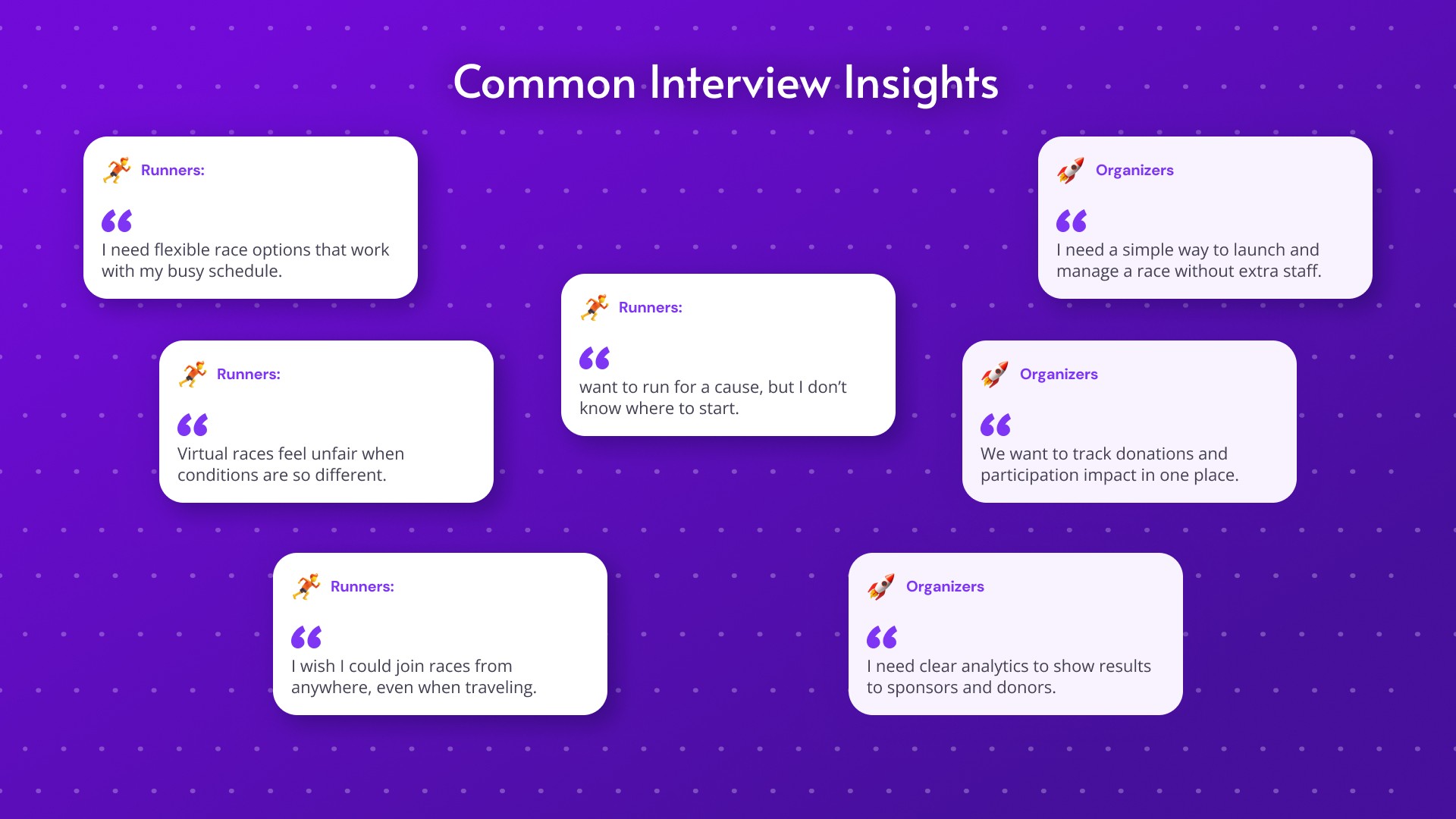
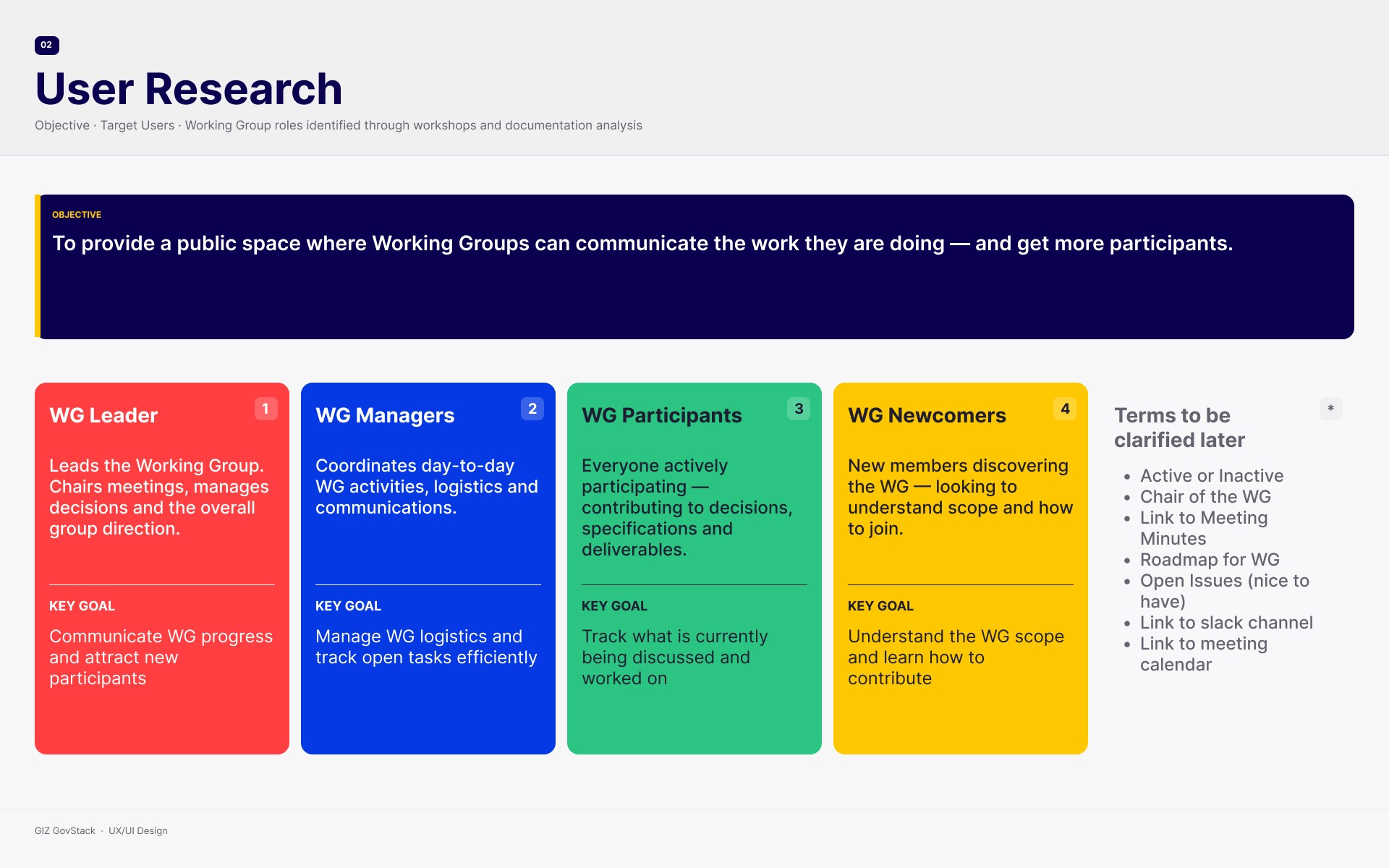
To shape the direction of OuiRace, I conducted interviews with a diverse group of users, including professional and amateur runners, trainers, charity organizers, corporate wellness leads, and race directors. I spoke with people who had participated in large-scale events like Memorun and those who organize local charity runs or team challenges for NGOs and companies. Given the number of distinct user types: runners, trainers, charity organizers, corporate wellness leads, and race directors, I used AI to help synthesise findings across segments, identifying shared themes and user-type-specific pain points simultaneously. This was especially useful for spotting contradictions: what felt "fair" to an experienced runner wasn't always what a casual participant expected, and surfacing that tension early shaped how I framed the AI correction feature in the UI.
Their insights revealed the need for a platform that ensures fairness in virtual racing, simplifies race setup, and integrates cause-based fundraising, guiding the core features of the app.


Competitive Analysis
In my competitive analysis, we examined 10 virtual and hybrid race platforms to understand current market offerings, user engagement strategies, and feature gaps. I used AI to structure and cross-reference findings across all 10 platforms quickly, mapping feature presence, audience focus, and monetisation models into a comparable matrix. This let me identify the scoring fairness gap in a single focused session rather than spending days manually compiling data, and gave me a clear foundation to bring into the brainstorm phase. I focused on four key competitors: JomRun, Myles, Gerak, and Strava to benchmark functionality, audience focus, and business models. The research revealed that while most platforms support basic tracking and social interaction, none provide a fair scoring model for virtual races or integrated fundraising tools for organizers. This uncovered a clear market gap for a platform like OuiRace, which offers equity-based rankings, race creation, and end-to-end event management.


Brainstorm
We held several co-design sessions both online and in-person in France, collaborating with our team and professional runners and trainers. Together, we defined key user needs, prioritized core features, and mapped out the user flow, ensuring the app reflects real racing scenarios and delivers a smooth, intuitive experience for both runners and organizers.

How I Designed it:
Ideation
UX Flow
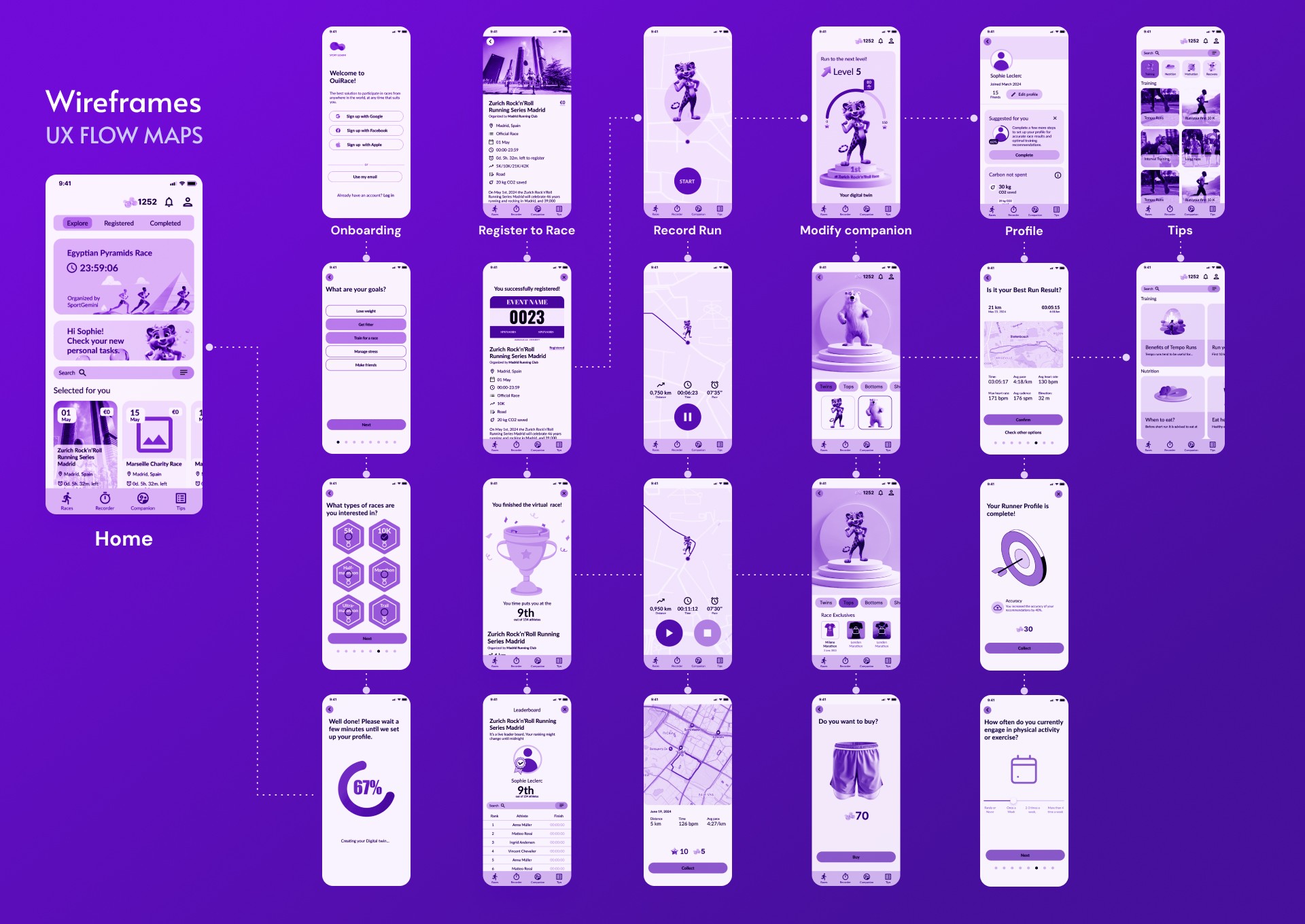
Throughout the design process, I iterated the UX flow multiple times, adding new steps, removing friction points, and simplifying navigation based on usability tests, beta-user feedback, and internal reviews. For each major revision, I used AI to quickly generate alternative flow structures, especially for the branching points between runner and organizer journeys, which had the most contested logic. This meant I could show the team two or three structurally different options within the same session rather than returning with a single refined version days later. Each version brought us closer to a flow that feels natural, efficient, and aligned with real user needs. The version shown here reflects the most refined and validated structure to date.



Wireframe
UX Flow Maps
I created these wireframes through many iterations, testing each flow with runners, trainers, and organizers. Several paths were simplified or removed based on user feedback and development constraints. What you see here is an earlier UX flow map that guided our decisions before moving into the final UI phase.
Iterations
I created the app’s visual identity from scratch, defining the logo, color palette, typography, and overall look and feel. During the early brand exploration phase, I used AI to generate mood-board variations and color direction candidates, giving the CEO and PM something concrete to react to within the first session. This shifted early brand conversations from abstract preferences to specific decisions, and the final identity emerged from refining rather than starting from blank.The system was shaped by the client’s requirements and refined through close collaboration, ensuring the identity supported the product’s goals while remaining clear, consistent, and distinctive.

Branding
Visual
I created the app’s visual identity from scratch, defining the logo, color palette, typography, and overall look and feel. The system was shaped by the client’s requirements and refined through close collaboration, ensuring the identity supported the product’s goals while remaining clear, consistent, and distinctive.


Final UI Design
Mobile
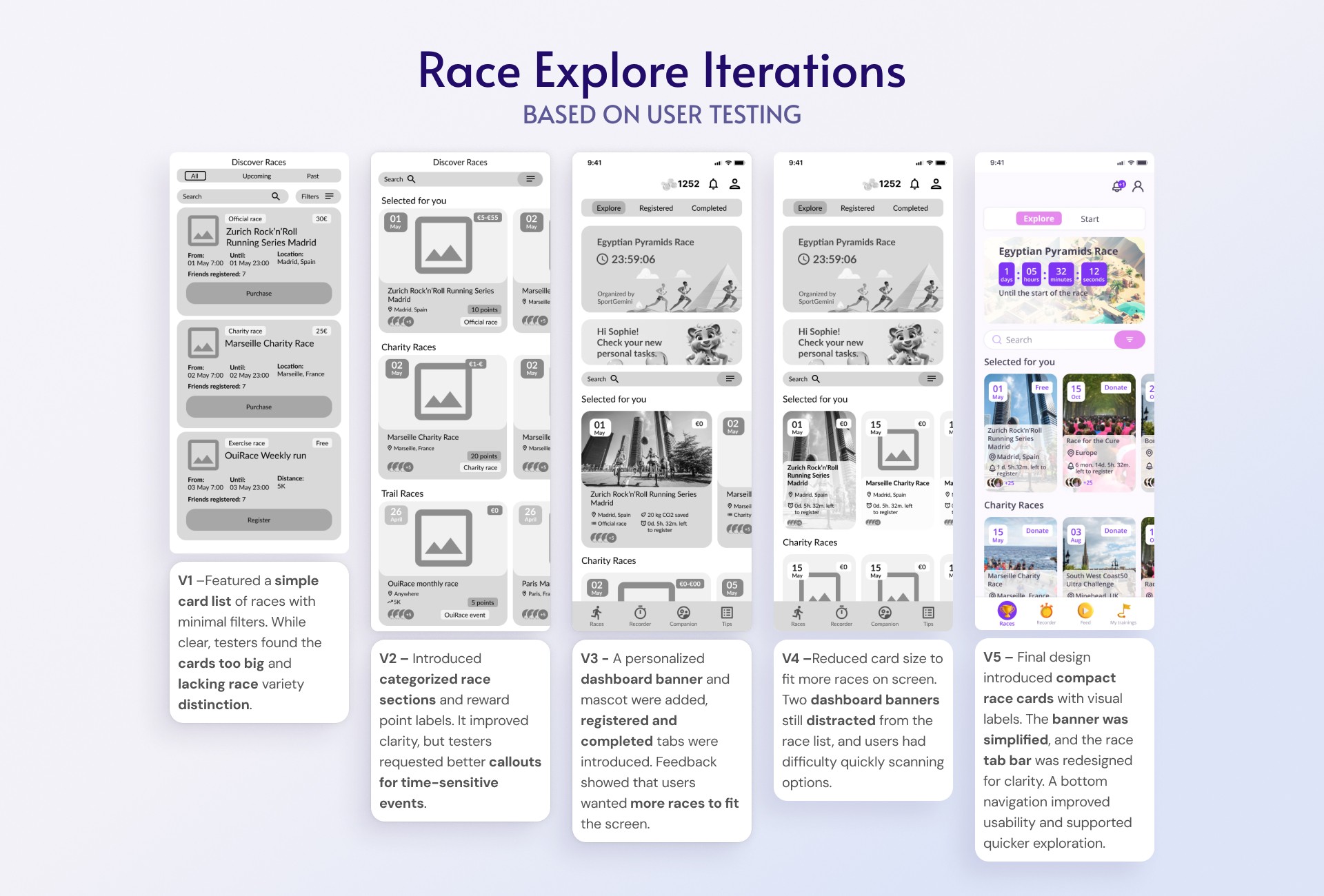
Throughout the OuiRace design process, I iterated extensively on race discovery, fairness mechanics, and in-race feedback based on user testing with runners and race organizers. Each iteration focused on clarifying complex concepts like time correction and virtual race validation, reducing cognitive load, and making the experience feel motivating and trustworthy for users. The time correction screens were particularly challenging, users needed to trust a result they hadn't seen calculated. I used AI to rapidly prototype different explanation approaches: numerical breakdowns, visual weather indicators, plain-language summaries. Testing these quickly with beta users helped me find the framing that felt clear without feeling over-engineered, significantly faster than iterating screen by screen alone.


Final UI Design
Web
Alongside the mobile app, I designed and developed a dedicated web platform where users can learn more about the app, its unique features, and the benefits it offers. The website also allows race organizers to create events and runners to register for upcoming races, providing a smooth entry point into the Racing App ecosystem.




Outcome
The Beta version of the app is now live, marking a major milestone in our mission to bring fairness, accessibility, and community-driven features to virtual racing. With the core experience in place, we’re actively refining the product through continuous user feedback, testing insights, and performance data.
We’re also proud to have established early partnerships with organizations such as Memo Run and an Alzheimer’s support group, reflecting our commitment to making running more inclusive and impactful. As we move forward, we’re expanding our collaborations to bring even more value to runners and race organizers worldwide—ensuring the app grows into a robust, trusted, and inspiring platform for all.